Rechargeable Invisible Hearing Aids: The Best No-Battery-Hassle Options in 2026
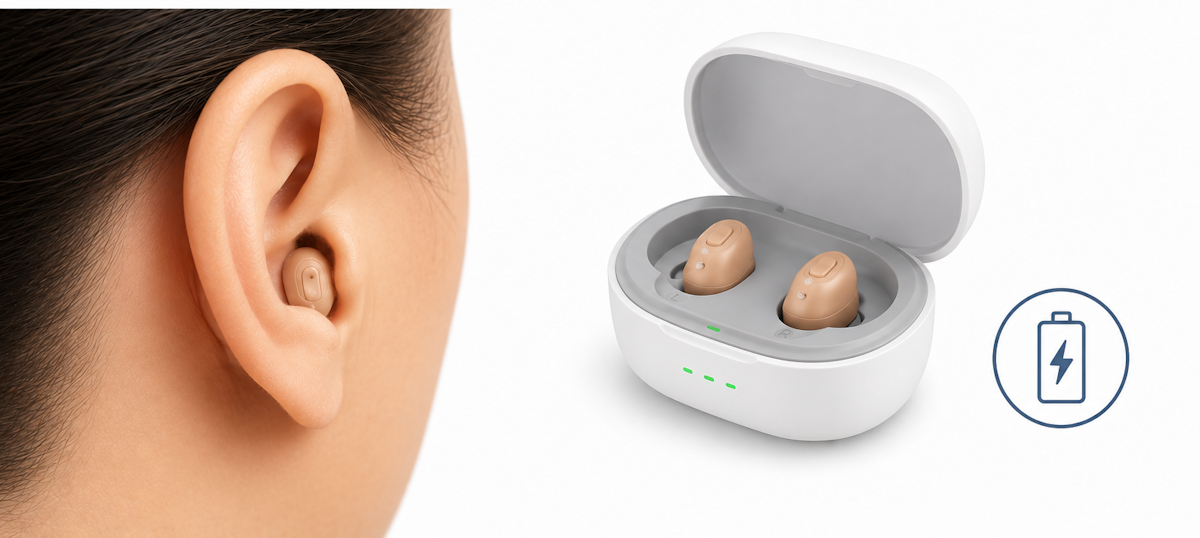
For years, one of the biggest trade-offs of choosing an invisible hearing aid was accepting a dependence on tiny disposable batteries — the size 10 or size 312 zinc-air cells that must be swapped out every few days. For users with dexterity challenges, vision impairments, or simply a preference for modern convenience, this was a real barrier.
In 2026, that trade-off is no longer unavoidable. A new generation of rechargeable invisible hearing aids has emerged — devices that deliver all-day power from lithium-ion cells and charge overnight in compact cases, without sacrificing the discreet in-canal form factor people want.
Why Rechargeable Matters for Invisible Hearing Aids
Disposable hearing aid batteries present several real-world challenges:
Frequency of replacement: Size 10 batteries (used in most IIC devices) last just 3–7 days. Size 312 batteries last 7–10 days. That adds up to dozens of battery changes per year — each requiring careful finger dexterity and good eyesight.
Environmental impact: A single hearing aid user goes through roughly 100–200 disposable batteries per year. Rechargeable systems drastically reduce this waste.
Total cost of ownership: Disposable batteries for both ears can cost $50–$150 per year. While the upfront cost of rechargeable aids is higher, the long-term savings are significant.
Convenience: A rechargeable model placed in its charging case overnight is ready for a full day of use. No fiddling with tiny batteries in the morning.
The challenge, historically, was fitting a lithium-ion cell inside a device small enough to sit invisibly in the ear canal. In 2026, miniaturized battery technology has overcome this barrier for CIC devices — and even some IIC-adjacent styles.
Best Rechargeable Invisible Hearing Aids of 2026
1. Signia Silk Charge&Go IX — World's First Rechargeable Instant-Fit CIC
The Signia Silk Charge&Go IX earns the top spot for rechargeable invisible hearing aids in 2026 for two reasons: it was the first rechargeable CIC on the market, and it remains the most refined. Unlike custom-molded CIC devices that require a multi-week wait for fabrication, the Silk uses pre-sized soft silicone Click Sleeves, allowing a same-day fitting.
- Battery life: Up to 20–28 hours per charge
- Charging time: Under 3 hours for a full charge
- Connectivity: Bluetooth LE Audio, Auracast support, app control via Signia app
- Sound processing: Dual processors with Own Voice Processing (OVP)
- Best for: People who want rechargeable convenience without a custom mold wait
2. Eargo 8 — Best Rechargeable OTC Invisible Hearing Aid
The Eargo 8 stands out as the most accessible rechargeable invisible option on the market — no audiologist required. It uses a patented floating ear tip design that sits comfortably in the canal while allowing airflow to reduce the occlusion effect. Its portable charging case holds up to 14 additional charges, giving users roughly two weeks of hearing between case charges.
- Battery life: 16 hours per charge
- Charging case capacity: 14 additional full charges
- IP rating: IP68 (submersible in 1m of water for 30 minutes)
- App: Eargo app (iOS and Android) with Smart Sound Adjust
- Best for: Mild-to-moderate hearing loss; prescription-free buyers
3. Oticon Zeal — Rechargeable IIC-Class Device with Auracast
The Oticon Zeal is one of 2026's most innovative entries: a rechargeable device that fits in an IIC form factor but delivers receiver-in-canal (RIC) level performance. It includes Auracast Bluetooth broadcast reception — allowing direct streaming from public Bluetooth audio systems — and Oticon's latest Deep Neural Network processing.
- Battery life: Full day on single charge
- Connectivity: Bluetooth LE Audio, Auracast
- Processing: DNN AI-powered sound classification
- Best for: Tech-forward users who want rechargeable IIC-level discretion with premium connectivity
4. Sony CRE-C20 — Best OTC Rechargeable for Simplicity
Sony's expertise in miniaturized audio engineering shows in the CRE-C20. An OTC rechargeable CIC device, it includes an onboard hearing test via the Sony Hearing Control app, which personalizes the sound profile to the user's specific hearing loss. Strong magnets in the charging case make reinsertion effortless — a thoughtful touch for older users.
- Battery life: Full day use per charge
- App: Sony Hearing Control (iOS/Android); includes onboard hearing test
- Best for: Tech-comfortable adults who prefer a self-fitting OTC solution
5. Audien Atom 2 — Best Budget Rechargeable Invisible Aid
For those on a tighter budget who still want rechargeability, the Audien Atom 2 delivers an impressive 24-hour battery life — the longest of any rechargeable model in this category — at a fraction of the price of premium options. It is operated via physical buttons (no app required), making it accessible for users who are not smartphone-inclined.
- Battery life: 24 hours per charge
- Price: Under $300 per pair
- Operation: Manual buttons (no app required)
- Best for: Budget-conscious users with mild hearing loss
Rechargeable vs. Disposable Battery Hearing Aids: Which Wins?
| Factor | Rechargeable | Disposable Battery |
|---|---|---|
| Daily convenience | High — just place in case | Moderate — manual battery swap |
| Dexterity requirement | Low | High (tiny batteries) |
| Battery life certainty | Predictable | Variable (zinc-air affected by humidity) |
| Cost over 3 years | Lower | Higher (ongoing battery purchases) |
| Environmental impact | Lower | Higher |
| Available in IIC form | Limited (2026 options emerging) | Most IIC models |
| Power for severe loss | Limited | Standard |
| Repair simplicity | Battery not user-replaceable | Battery user-replaceable |
For most users choosing between a rechargeable CIC and a disposable-battery IIC Hearing aid, the rechargeable CIC wins on practicality in everyday life. The size and visibility difference between the two is minimal under real-world conditions.
What to Look for When Buying a Rechargeable CIC Hearing Aid
Battery life: Look for a minimum of 16 hours per charge to cover a full waking day. Some models, like the Audien Atom 2, offer 24 hours.
Charging case portability: A compact charging case that stores additional charges (like the Eargo 8's case with 14 extra charges) is a major convenience advantage for travelers.
Connectivity: Decide whether Bluetooth streaming is important to you. The Signia Silk Charge&Go IX and Oticon Zeal both offer Bluetooth LE Audio, while budget options like the Audien Atom 2 do not.
Trial period: Rechargeable hearing aids represent a meaningful investment. Always choose a product with a minimum 30-day — ideally 45–100 day — trial period. The Eargo 8 offers 45 days; the Audicus Mini 2 offers 100 days.
Warranty: A minimum two-year manufacturer's warranty is standard for reputable brands. Confirm coverage for the battery itself, as rechargeable battery capacity degrades over time.
FAQs: Rechargeable Invisible Hearing Aids
How long do rechargeable hearing aid batteries last before they need replacing?
Lithium-ion batteries in hearing aids typically maintain strong performance for 3–5 years before capacity noticeably degrades. At that point, the device usually needs to be returned to the manufacturer or clinic for battery replacement — a service most brands provide.
Can rechargeable invisible hearing aids get wet?
Most rechargeable CIC Hearing Aid models in 2026 carry an IP68 water resistance rating, meaning they can withstand submersion in up to 1 meter of water for 30 minutes. They are generally safe during sweating, light rain, and incidental water exposure. Swimming and showering habits should be confirmed against the specific product's specifications.
Are rechargeable hearing aids more expensive than battery-powered ones?
Upfront, yes — rechargeable models typically cost slightly more than their disposable-battery equivalents. Over a 3–5 year ownership period, however, the elimination of battery purchases usually results in a lower total cost.
What happens if my rechargeable hearing aid runs out of power during the day?
Most rechargeable CIC devices offer a quick-charge function — 15–30 minutes of charging can provide several hours of use. Carrying the charging case provides backup power during extended days away from a power outlet.